




Massachusetts Legislature Approves Significant Amendments to the Zoning Act
The Massachusetts Legislature in its Fiscal Year 2027 budget bill has approved legislation that makes several important and transformative amendments to the Massachusetts Zoning Act (M.G.L. c. 40A). Signed by the Governor on July 9, 2026, the bill contains an emergency preamble, which means these changes take effect immediately.
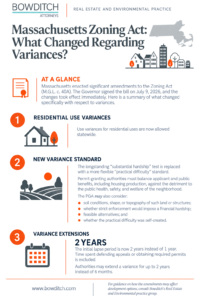
Residential Use Variances
G.L. c. 40A, §10 was amended to allow use variances for residential uses statewide. Previously, use variances were only available when specifically authorized in a zoning bylaw or ordinance. The statute now provides:
“Except where local ordinances or by-laws expressly permit variances for use, no variance may authorize a use or activity other than residential, not otherwise permitted in the district in which the land or structure is located…” (Emphasis added).
This provides a critical pathway forward for applicants seeking to pivot from commercial and non-residential uses, where they otherwise needed to seek zoning amendments from a town meeting or a city council, which is typically a lengthy and political process.
A New Standard for Variances
Perhaps the most significant change is the complete replacement of G.L. c. 40A, §10 governing variances. For decades, Massachusetts maintained one of the most demanding variance standards, requiring applicants to demonstrate “substantial hardship” relating to unique soil conditions, shape, or topography.
The amendments to G.L. c. 40A, §10 replace that longstanding hardship test with a more flexible “practical difficulty” standard. In evaluating a variance request, local permit granting authorities would balance the benefits to both the applicant and the public interest, including the interest in supporting the production of housing, against any detriment to the health, safety, or welfare of the neighborhood. The revised statute also allows boards to consider several other factors, including:
- Whether the practical difficulty relates to site conditions;
- Whether strict application of the zoning bylaw would create financial hardship;
- Whether a feasible alternative exists; and
- Whether the hardship was self-created.
More Flexibility for Variance Extensions
The bill also revises the lapse provisions applicable to variances. Variance rights will now only expire after two years (previously one year) if not exercised, but the legislation now expressly excludes time spent defending appeals or obtaining other required permits.
Additionally, permit granting authorities may extend variance rights for up to two additional years upon timely written application, where previously a municipality could only extend for a period of six months.
Expanded Flexibility for Nonconforming Structures
G.L. c. 40A, §6 will now allow, without a special permit, the extension or alteration of a pre-existing nonconforming structure or residential use that does not comply with lot size, lot shape, lot frontage, lot coverage, or floor area ratio, so long as that proposed extension or alteration will comply with the then-current height, stories, and setback dimensional regulations in that zoning district. This amendment should support increased housing production by expanding the ability to develop, expand, or reconstruct buildings on pre-existing nonconforming lots.
Extended and Clarified Zoning Freeze Protections
G.L. c. 40A, §6 was further amended to extend the zoning freeze period from 12 to 24 months for an approved project. For projects proceeding under building permits, the bill clarifies that zoning protection continues so long as construction commences within 24 months after issuance of the final permit required for construction.
- Importantly, this 24-month period is tolled while an applicant is actively pursuing other necessary permits.
- Previously the statute only provided protections for projects for which a prior zoning approval had issued. This helps to prevent strategically targeted zoning changes when a community learns of a controversial project.
Additionally, municipalities may not deem nonconforming uses and structures abandoned or not used unless a period of four years or more has passed (where previously the limit was two years).
Electronic Notices
G.L. c. 40A, §§5 and 11 now provide municipalities with the ability to use more modern forms of communications, such as electronic mailing of notices for public hearings for zoning amendments, special permits, and variances.
The amendments to the Zoning Act represent substantive policy reforms that will change the rules for municipalities, permitting authorities, developers, and property owners throughout the Commonwealth. For insights on how these amendments may impact your development options, please contact the land use and permitting attorneys at Bowditch.
Categorized: Legislation, Zoning
Tagged In: land use, Massachusetts Zoning Act, nonconforming structures, residential use variances, zoning variances